Why Silverware Handles Change Shape at the Grip
Why silverware handles change shape at the grip: learn to read how task, hand position and visual balance shape a spoon, fork or serving tool.
The common mistake when reading silverware is to treat the handle as decoration added after the useful part. That misses the design decision at the point where fingers meet metal, and can make a serving spoon seem awkward or a plain fork look oddly elaborate. To understand why silverware handles change shape at the grip, begin with the object’s task, then follow the hand and the line of the piece.
What is the object meant to do?
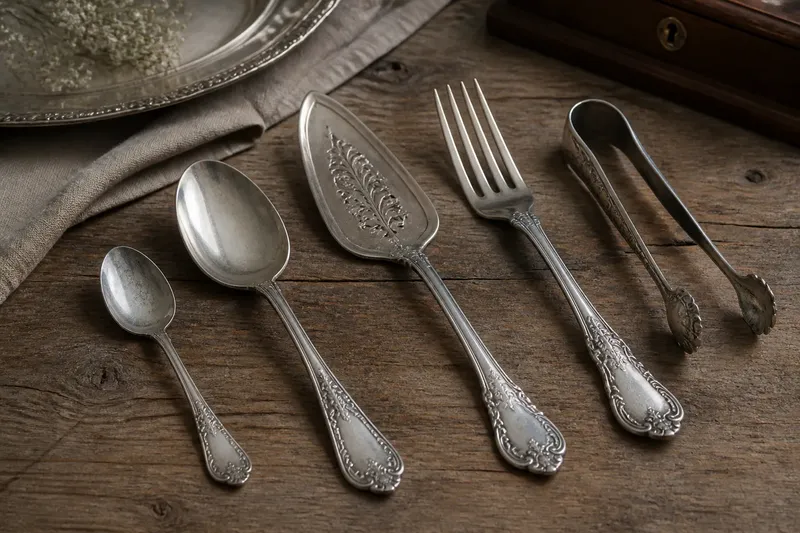
Start at the working end, not the handle. A teaspoon, fish slice, carving fork and sugar tongs ask different things of the hand. One is lifted repeatedly for small portions; another must support food across a serving dish; a third needs a firm, directed hold. Their handles respond to those demands, even when their ornament belongs to the same pattern.
Look at the bowl, tines, blade or jaws. Note its direction, width and relationship to the handle’s centre line. A spoon bowl that sits at an angle may ask the wrist to approach the mouth or a dish differently from one aligned straight with the shaft. A serving piece with a broad head may need a handle that allows it to be turned without the fingers crowding the food.
Do not infer a precise historical use from shape alone. Instead, ask what movement the object makes plausible: scooping, piercing, lifting, spreading, cutting or pinching. The handle is often a clue to the movement the maker expected, rather than a label for the object.
Where does the hand settle?
Find the grip area by looking for changes in width, thickness, contour or surface. The handle may swell where the palm rests, narrow beneath the fingers, or flare towards the terminal. Some forms offer a shallow hollow or a ridged edge; others remain flat and rely on a broad, simple outline. These changes can be subtle, but they organise the hand’s contact with the silver.
Imagine holding a serving spoon whose shaft narrows just before a broad terminal. The fingers can close around the narrower section while the end remains visible beyond the hand, giving the piece a clear direction. If the same spoon had an equally broad shaft throughout, the grip might feel less defined and the terminal could seem visually detached. That is an invented reading of form, not a claim about any particular object.
When handling an antique or fragile piece, support it gently and avoid twisting a loose or damaged handle. For an object that should not be handled, read the grip from its outline, side profile and signs of wear instead.
How does the handle meet the working end?
Trace the transition from terminal to grip and from grip to neck or shaft. A gradual taper can make the whole object seem to flow towards its bowl or tines. A sudden shoulder, collar or change in plane can mark the point where the hand should stop. Neither is automatically more comfortable; each gives the piece a different physical and visual rhythm.
Check the side view as well as the face. A handle that looks broad from above may be thin in profile, while a raised ridge can make a flat-looking form easier to orient. The transition may also compensate for the working end. A heavy head can be visually balanced by a substantial grip, while a fine, narrow tool may keep its handle slender so the object does not look overbuilt.
Observe the junction closely. A collar or stepped shoulder might be part of the original design, a join, or a later repair. Do not assume that every change in contour was intended for the fingers; some belong to construction or to the meeting of separately made parts.
What does the profile tell you?
Turn the piece in your mind, or view it from several angles if it is safe to do so. A rounded grip distributes contact differently from a flat-backed one. A handle with a pronounced ridge may offer a preferred orientation, useful when the working end must face a particular way. A symmetrical handle can be turned more freely, though symmetry alone does not tell you how it was used.
Compare the outline at the grip with the outline at the terminal. If both are similarly broad, the maker may have sought a continuous, weighty silhouette. If the grip narrows and the end expands into a finial, the handle draws the eye towards its tip. Ornament can strengthen that effect, but even an unadorned change in width can establish a visual endpoint.
For a useful reading, separate what you can observe from what you are guessing. “The handle thickens below the neck” is an observation. “It was made for a larger hand” is an interpretation that needs more evidence. Shape gives you a sound starting point, not a biography of its owner.
How do ornament and balance work together?
Decorative details often gather at the terminal, the grip or the junction between them. A crest or leaf-shaped end can make the handle visually top-heavy. A narrow band at the neck can draw attention to the transition instead. Look at how the ornament relates to the point where the fingers would close: a raised motif placed directly under the thumb may affect the feel, whereas a flat engraving may chiefly change the appearance.
Balance is both physical and visual. A handle can appear to counter the mass of a broad spoon bowl without having a corresponding mass that you can establish by sight alone. When considering the object in use, notice whether its shape suggests a secure hold and a controlled direction. When considering its appearance, notice whether the eye travels smoothly from working end to terminal or pauses at a strong change in width or decoration.
Compare pieces from the same service, if available. A dinner fork and a serving fork may share a terminal motif but differ at the grip because one is used close to the plate and the other must reach into a dish. The recurring ornament ties them together; the changed proportions acknowledge different work.
What should you look for in a handle?
- Working end: Identify the bowl, tines, blade or jaws, then describe the movement it permits.
- Grip zone: Find where the width, thickness or contour changes under the fingers.
- Orientation: Check whether a ridge, flat face or angled neck favours one direction of use.
- Transition: Note how the handle joins the shaft and whether the change is gradual, stepped or collared.
- Profile: Compare the front view with the side view; they may present different proportions.
- Terminal: See whether the end repeats, balances or contrasts with the working end.
- Condition: Look for bending, looseness, repairs or wear that could alter the original form.
These observations are more useful than deciding immediately that a handle is elegant, clumsy or comfortable. They give you language for comparing pieces without assuming that every object was designed for the same hand or setting.
What questions help you read a silverware handle?
Why does a spoon handle widen at the end?
A wider terminal can give the handle a visual stop and help distinguish its end from the grip. Its shape may also relate to a pattern shared with other pieces, so treat the terminal as both a design feature and a possible aid to orientation.
Does a heavier-looking handle mean the object is unbalanced?
Appearance alone cannot settle that. The working end, handle profile and actual condition all affect how the piece sits in the hand, and a broad terminal may look weighty while remaining thin in profile.
Can handle shape identify what a piece was used for?
It can suggest a task when read alongside the working end, but handle shape by itself is rarely decisive. Compare the whole object and leave room for uncertainty, especially if it has been repaired or adapted.
Why do matching pieces have different grips?
Matching ornament can unite a service while different proportions suit different movements. A table fork and a serving implement may share a terminal design but need distinct grip lengths, widths or angles.
How can you turn the reading into a useful comparison?
Choose two related pieces and describe each in the same order: working end, grip, transition, profile and terminal. Keep the descriptions factual before adding an interpretation. For instance, one may have a straight shaft and a narrow grip, while the other has a bent neck and a fuller handle. You can then ask how those differences suit their tasks, rather than treating variation as inconsistency.
That method also helps when viewing silver behind glass. A side-on view may reveal a bend hidden in a frontal display; a photograph of the terminal may show a repeated motif, while the grip itself remains plain. If a detail is unclear, record it as uncertain instead of filling the gap with a confident story.
Why silverware handles change shape at the grip is ultimately a question about relationships: the hand must meet the task, and the handle must make that meeting legible in the object’s outline. Next time you pick up a spoon or study a serving fork, follow the metal from its working end to the place the fingers would rest. The change in shape often tells you more than the decoration placed at either end.