The Tarnish Shortcut That Can Do More Harm Than Good
Silver tarnish is not always a defect. Learn when to leave darkened areas alone, how to clean cautiously and what to do about stubborn patches.
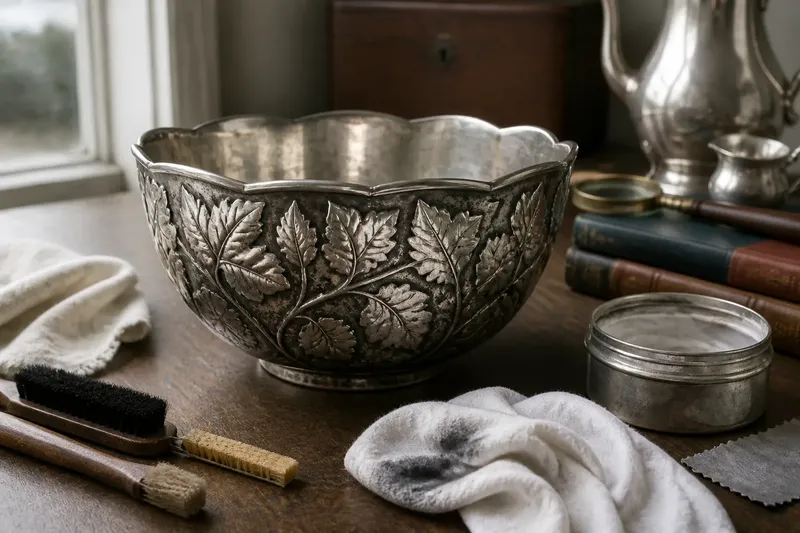
The common mistake with silver tarnish is to treat every dark patch as dirt and reach for the strongest polish available. That shortcut can cost an object its original finish, the contrast that makes its details legible, or a little more of its surface each time it is repeated.
Silver tarnish is a change at the surface, often caused by contact with sulphur compounds in the surrounding air or materials. It can look dull, grey, brown or nearly black. On a spoon used at dinner, a dark patch may simply be unwanted discolouration. In the recesses of a chased bowl, the same darkness may be part of the intended appearance, or a record of how the object has been handled and kept.
The useful question is not how to make every part bright. It is whether the change is harmful, whether the object was meant to be uniformly bright, and what the least damaging response would be. Silver polish is not a neutral reset button: it removes tarnish, but abrasive products can also remove silver and alter a deliberately darkened surface.
Why does the quick polish cause trouble?
Many silver polishes work partly by abrasion. They contain fine particles that help scour away surface tarnish as the cloth moves across the metal. A soft cloth can still carry an abrasive compound, so “soft” describes the fabric, not necessarily the action.
Repeated polishing can soften crisp engraving, wear down raised detail and leave fine scratches that scatter light. A thinly silver-plated object has a different margin for cleaning from a solid silver one: if its coating wears through, the metal beneath may show. Even a solid silver object can lose definition or finish through unnecessary rubbing.
There is another cost: uniform brightness can erase the difference between raised areas and recesses. Some silver was intentionally oxidised or darkened to make patterning stand out. On such an object, polishing every hollow until it matches the high points may leave the design flatter to the eye. The result can be shinier and less faithful at the same time.
Is the dark area tarnish, or part of the finish?
Start with the object’s form and surface rather than the colour alone. Look at the change under steady, indirect light. Is it a broad, fairly even haze, or darkness concentrated in engraved lines, pierced work and other recesses? Does the darkening appear in places that would naturally collect handling residue, or does it follow the design with deliberate precision?
Check for signs of a special finish, including a deliberately darkened background, a soft satin surface, gilded details or a coating intended to protect the metal. A maker’s mark, care label, old inventory note or family description may help, though none of these should be treated as a cleaning instruction by itself. If an object is plated, antique, unusually decorated or of uncertain construction, consider leaving it alone until a conservator or reputable silversmith can assess it.
Say you inherit a small silver bowl with bright raised leaves and dark lines between them. If the dark areas closely follow the engraved pattern, the cautious choice is to avoid polishing those lines simply because they are darker. A gentle dusting and a closer look at the bowl’s construction may be enough to decide that its contrast is part of its character; if the surface remains uncertain, a conservator can advise before anything is removed.
What should you try before using polish?
Begin with the least intervention that could address the actual problem. If the object is dusty, use a clean, soft brush or a soft dry cloth, taking care around catches, joints and delicate decoration. Dust is not tarnish, and polish is a poor way to remove it.
If the object has ordinary handling marks, a clean, lint-free cloth may lift loose residue with very light contact. Do not scrub at a spot to make it disappear. A persistent patch may be tarnish, a change to the finish, an old repair or a material transferred from something else; rubbing harder does not tell you which.
For an object that is clearly intended to be bright silver and has no fragile coating or special finish, use a polish made for silver and follow its label. Apply it sparingly with a suitable cloth, work gently, and stop if the cloth picks up an unexpected colour, the surface becomes patchy, or detail seems to change. Manufacturer instructions and the object’s condition matter; where either is unclear, ask a qualified conservator or silversmith rather than improvising with household cleaners.
What are the usual polishing problems?
Why does the silver look streaky after polishing?
Streaks can come from uneven product, residue left in crevices or a finish that was never meant to become uniformly bright. Stop adding polish, remove any remaining product only as its label directs, and inspect the surface in indirect light. If the streaks persist or the finish looks altered, do not keep rubbing to even them out.
Why is the cloth turning grey or black?
A dark mark on a polishing cloth can be tarnish and polishing residue, but it is not a reliable measure of how much cleaning is needed. Use a clean part of the cloth and stop when the object reaches the appearance you intend to preserve. Continuing until the cloth stays spotless can encourage needless abrasion.
Why is a dark patch not coming off?
The patch may be intentional oxidation, a coating, embedded residue or a surface change that ordinary polish will not safely remove. Do not switch to a harsher compound or use a sharp tool to pick at it. Identify the object and its finish first, and seek specialist advice if the mark is important or the surface is valuable.
What if the silver is plated?
Plating is a thin layer over another metal, so aggressive or frequent polishing can expose the material beneath. Avoid abrasive treatment when the coating is worn, bubbled, flaking or already showing a different colour. A silversmith can advise whether careful cleaning or replating is appropriate.
How can you prevent another round of polishing?
After handling, wipe the object gently with a clean, dry cloth to remove fingerprints and moisture. Store it somewhere dry and away from materials that may transfer sulphur compounds, such as some rubber products, wool and certain papers. A tarnish-resistant silver cloth or purpose-made storage material can help, provided it does not press against fragile decoration or trap dampness.
For display, avoid placing silver where it is exposed to cooking fumes, damp air or frequent handling. Keep it away from direct contact with painted, varnished or unknown surfaces that could transfer residue. Do not wrap it in cling film or store it in a damp cupboard; a confined, humid environment can create other problems even if the object is not being used.
Keeping silver clean does not mean keeping every part bright. The sensible response to silver tarnish depends on the object’s material, finish and intended appearance: remove loose dust, treat clear and ordinary tarnish gently, and leave uncertain or design-defining darkness in place until you know what it is. Sometimes the best polish is the one that stays in its tin.