Hammered or Smooth Silver: Which Finish Suits a Small Decorative Object?
Hammered or smooth silver changes how a small object catches light. Compare the finishes by display setting, form and desired evidence of making.
The common mistake with hammered or smooth silver is choosing from a close-up photograph, where every glint looks persuasive. On a small decorative object, the wrong finish can make a delicate form seem busy or a simple one seem blank; the surface determines how the object reads from across a room as well as in the hand.
For a compact bowl, box, candlestick or sculptural ornament, the useful question is not which finish is finer. It is what you want the light to do, and how much evidence of making you want the surface to show. Smooth silver gathers reflections into broad, legible shapes. Hammered silver breaks them into smaller flashes and shadows.
What does each finish do to light?
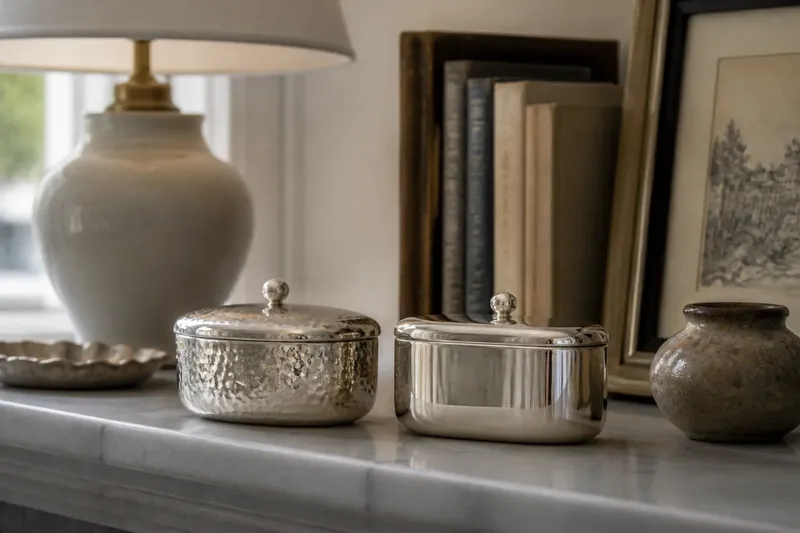
A smooth, polished surface behaves like a quiet reflector. It can carry a window, a lamp or a dark patch of the room as a clear band of brightness. On a curved object, that reflection travels over the form, making the outline and changes of contour easy to read.
A hammered surface interrupts the reflection. Each shallow dent tilts the light slightly differently, so the object produces a shifting field of glints rather than one continuous image. The effect can feel lively and tactile, but it also makes the silhouette less immediately calm.
Neither finish simply makes silver brighter. A polished surface may appear dark where it reflects a dark room; a hammered one may sparkle in several directions without looking uniformly bright. The quality of the light depends on the shape, the room and the angle of view, not just the name of the finish.
Which finish suits the way you will display it?
Choose smooth silver if the object will sit near a clear window, a lamp or another strong source of reflected light, and you want its outline to remain easy to follow. It is also a natural fit for a restrained interior, where a broken pattern of highlights might compete with nearby objects.
Choose hammered silver if the object will be seen from several angles, or if you want the surface itself to add movement when the light changes. The texture can give a small, plain form more visual presence without requiring an elaborate silhouette.
In a crowded display, restraint may be more useful than sparkle. A smooth piece can act as a visual pause among patterned ceramics, books and framed objects. In a sparse arrangement, hammered silver can supply surface interest while the surrounding space remains simple.
Imagine a small silver box intended for a narrow mantel beside a lamp. If its owner wants the lid and edges to read clearly against a crowded background, a smooth finish is likely to suit the brief. If the same box will sit alone on a pale shelf and be viewed while someone moves through the room, a gently hammered finish may give it more changing points of light.
How much should the object’s shape decide?
Shape and finish work together. Smooth silver tends to make a clean edge, a rounded shoulder or a shallow curve easier to see. It is useful when the form is the main visual idea: a neat cylinder, a low dish or a small vessel whose proportions deserve attention.
Hammering can make a plain volume feel less anonymous. On a rounded form, uneven reflections help register the curve as the viewer shifts position. On a form already full of ridges, handles or cut-out details, however, more surface activity may muddle the outline.
Think of the finish as part of the object’s visual vocabulary. A simple form can carry a more expressive texture; a complicated form may benefit from a calmer surface. This is not a rule about quality. It is a way to decide where the eye should settle first.
Do you want to see evidence of making?
Hammer marks make labour visible. Their rhythm, depth and variation can suggest that a maker shaped the surface through repeated blows, rather than leaving it as an undifferentiated plane. The marks may be regular and orderly or deliberately varied; either way, they give the object a readable surface history.
Smoothness can also disclose making, but in a different register. A polished surface draws attention to proportion, continuity and the meeting of parts. If the transitions are well resolved, the absence of visible texture can feel deliberate rather than empty. A surface that looks smooth from a distance may still show fine marks in close light.
When considering an existing object, look across it rather than only down at it. Turn it slowly, if handling is appropriate, and notice whether reflections remain continuous or break into small facets. The change in light can help distinguish a genuinely textured surface from a finish that merely appears uneven in one photograph.
What should you check before choosing?
- Viewing distance: At arm’s length, does the finish read as a clear plane or as a lively texture? Choose the effect that remains legible where the object will usually be seen.
- Lighting: Will the object reflect a window, a lamp or a dim corner? Consider whether you want a broad reflection or scattered highlights.
- Silhouette: Does the shape rely on a crisp edge or a simple curve? Smoothness may clarify it; hammering may soften its visual definition.
- Nearby objects: Are patterns and reflective surfaces already competing for attention? A quieter finish may keep the display composed.
- Making marks: Do you want the surface to show a visible working rhythm? If so, inspect how the hammering is distributed rather than assuming all hammered finishes look alike.
- Touch and handling: Will people often pick the object up? Consider whether the texture is part of the intended tactile experience, while keeping the object’s purpose and care needs in view.
Which finish fits your situation?
Which finish works in a bright room?
Smooth silver suits a display where you want to read reflections as broad shapes and follow the object’s contour. Hammered silver can be a better choice if those clear reflections feel too dominant and you prefer them broken into smaller glints.
Which finish makes a simple form feel more distinctive?
Hammering can add visual character to an uncomplicated bowl, box or ornament without changing its outline. Smooth silver is preferable if the form itself already has a strong profile that should remain the first thing you notice.
Which finish is easier to combine with patterned objects?
A smooth finish often sits more quietly beside decorated ceramics, engraved glass or patterned textiles. A restrained hammered texture can still work, but a strongly irregular surface may add another competing pattern.
Can one object combine hammered and smooth areas?
Yes: a polished rim or smooth panel can set off a hammered body, making the boundary between the two finishes part of the design. The contrast is clearest when each area has a distinct role, rather than a small, fussy patchwork of effects.
How do you compare objects fairly?
Compare pieces under the kind of light in which they will live. A photograph can flatten hammer marks, exaggerate polish or catch one convenient reflection. If you can see an object in person, shift your position and notice what happens to its highlights; if you are choosing from images, look for more than one angle and for a view that shows the surface obliquely.
Also separate finish from colour and form. Two silver objects can look different because one is darker, more curved or more ornate, not because one is hammered and the other smooth. Compare like with like where possible: similar shapes, similar lighting, and a similar distance from the eye.
For a small decorative object, hammered or smooth silver is ultimately a choice about visual attention. Pick smooth silver when you want reflections and contours to stay composed; pick hammered silver when the surface should contribute its own rhythm. The best choice is the one that makes the object’s intended character clear in the place it will actually occupy.