Before the Keepsake Box: Silver Objects in the History of the Table
Silver objects at the table turned serving into a visible welcome. Learn how to read trays, spoons and vessels through their use, setting and handlers.
The common mistake is to treat silver on a table as decoration rather than equipment. That misses what the objects did: a spoon transferred food, a tray carried cups, and a covered dish kept a meal ready to serve. Their cost also shaped who could own them and, in some households, who had the time and skill to maintain them.
How did serving become a public gesture?
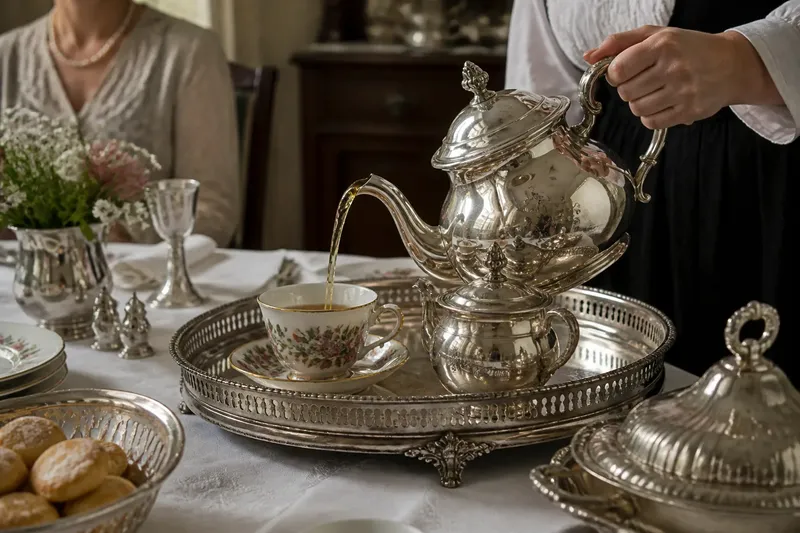
A serving spoon passes food from vessel to plate; a tray carries cups across a room; a covered dish holds food until it is offered. Each action makes an exchange visible. Someone serves, someone receives, and other people at the table can see the sequence.
Silver could draw attention to these actions because its surface reflected light and its forms were made for particular tasks. It did not create hospitality by itself. The setting mattered: a teapot used during an ordinary family breakfast had a different role from one brought out for visitors.
To read the object, look at when it appeared, who handled it and what was offered. A well-used spoon may have belonged to routine; a large tray reserved for guests may have marked a special occasion. Shape alone does not settle the question.
What did formal service make visible?
In some affluent households, formal meals used dedicated serving pieces and assigned tasks to different people. A host might present a dish, while a servant carried it around the table. The arrangement made the act of serving visible to guests, while preparation and cleaning often happened elsewhere.
Compare a bowl set within reach with a covered dish carried to a guest. The food could be similar, but the second action turned presentation into part of the meal. A silver vessel’s shape might identify whether it was meant for pouring, carrying or serving.
Where servants maintained silver, a polished coffee pot also reflected their labour. Cleaning and handling kept the object ready for use, even when guests saw only the finished surface. This point applies to households where such service existed; it should not be taken as a description of every home or period.
Why did particular silver objects carry ceremony?
Repeated use linked objects to household routines. A salver used to bring a welcome drink could become associated with arrivals; a serving spoon might appear at both family meals and formal dinners. The association came from use as well as form.
Some objects made public gestures easier to recognise. A tea or coffee service made pouring visible; a goblet could be raised for a toast; a salver let a small item be presented rather than simply set down. Handles, balance and size served practical purposes, while also shaping how an object moved through a room.
Imagine a household preparing tea for a visiting neighbour. The host takes a silver teapot from a cupboard, asks a family member to carry it in, then pours while conversation pauses. The observable result is modest: attention shifts briefly to the welcome, and tea-making becomes a shared gesture rather than a task kept in the kitchen.
What can silver say about status and household work?
A collection of matching serving pieces could suggest that a household had the resources to acquire and maintain them. One prominent object could make a more selective display. Neither arrangement tells the whole story: guests’ readings depended on local expectations, and the same vessel could seem hospitable to one person and ostentatious to another.
Ownership and use were not always the same. The person who owned a teapot might not carry it; a guest might receive a cup without doing the work of preparing or cleaning the service. At the table, a polished object could make the meal look orderly while the labour behind it remained out of sight.
These distinctions varied by household and setting. Silver may offer clues about who served, who received and who maintained an object, but it cannot identify those people on its own. Look for evidence in the object’s wear, its arrangement and any reliable information about the household before drawing a conclusion.
How did silver at the table become family memory?
An object could outlast the occasion for which it was first acquired. A tea service used for visitors might later appear at family gatherings, or be kept for rare occasions. As routines changed, the object stayed recognisable while its role shifted.
A familiar spoon may recall a meal or a particular person’s way of serving. That personal association can sit beside an earlier role as a sign of hospitality or household resources. The object preserves its material form; memory often centres on the gesture made with it.
What questions help read silver table customs?
What action was this object made to perform?
Look at its shape: a handle may help with carrying, a spout with pouring, and a broad bowl with serving. Then compare that likely use with any wear or marks that are clearly visible.
Where and when did it appear?
Ask whether the object was used at an everyday meal, brought out for guests or reserved for a particular ceremony. If its setting is unknown, keep the answer open rather than treating its form as proof of a formal occasion.
Who handled it, and who received what it carried?
Consider who could reach the object and who performed the serving, pouring or cleaning. Separate what the arrangement suggests from what is actually known about the household.
What changed as the object passed between generations?
Compare its earlier use, if known, with the way it is used or displayed now. A family association may have grown later, alongside or instead of its original role.
- Check the form: if the object has a spout, consider pouring as its likely task; if not, look for a different use rather than assuming it held a drink.
- Check visible wear: if a handle or rim shows wear consistent with frequent handling, consider regular use; if wear is slight or unclear, do not infer that it was reserved for ceremony.
- Check the setting: if reliable family information places it at daily meals, describe it as part of routine; if it appears only in accounts of guest occasions, describe that narrower role.
- Check who is documented handling it: if a named person carried or served from it, distinguish that action from ownership; if no handler is known, leave the question unresolved.
- Check what it carried: if records or family accounts identify tea, food or another offering, connect the object to that exchange; if the contents are unknown, describe only the object’s likely function.
- Check changes in use: if later accounts place it at family gatherings, note that its role shifted; if its later use is unknown, avoid claiming that a keepsake meaning was always present.
Say you inherit a teapot with a spout and handle, slight wear near the handle, and a family note saying it was brought out for visiting neighbours; the note names your grandmother as its owner but says nothing about who carried it. First, identify pouring as the likely task from the spout. Next, treat the wear as consistent with handling, not proof of daily use. Then use the note to describe guest service, while keeping the carrier unknown. The resulting account is specific without turning a family clue into a complete history.
Silver objects at the table make most sense when read through the actions they enabled: carrying, pouring, offering and receiving. For silver table customs, the useful questions are not only who owned the object, but where it appeared, who handled it and what the exchange meant in that household. If those details are missing, saying so is more informative than polishing uncertainty into a story.