A Place Setting Built Around One Silver Serving Piece
A place setting built around one silver serving piece can feel deliberate, not sparse: use contrast, clear space and a restrained palette to give it purpose.
The common mistake with a place setting built around one silver serving piece is adding matching silver until the table looks like a display cabinet. The extra pieces compete for attention, crowd the food and make the object’s role harder to read. A better arrangement gives the serving piece a clear job, then uses colour, texture and space to support it.
Which silver piece should anchor the table?
Choose the object by what it will do during the meal, not only by how impressive it looks. A broad serving spoon, a small ladle, a sauce boat or a covered dish can each become the visual centre, but the table plan should make its use obvious.
Think about where the piece will be placed and who will reach for it. A serving spoon belongs beside the dish it serves; a sauce boat needs a stable patch of table and room for a hand to lift it. A decorative object with no role can still be displayed, but it should sit outside the working route of dishes and guests.
Look at the piece in ordinary room light before choosing the rest of the table. Silver reflects nearby colours, so a polished surface may pick up a dark runner or a bright napkin more strongly than expected. A softly finished or engraved piece can read differently, but there is no need to turn that observation into a second silver collection.
How should the silver serving piece relate to the meal?
Give it a practical relationship to one course or shared dish. The piece should either serve something, contain something, or mark a deliberate point in the meal. That connection prevents the setting from feeling like a still life assembled without regard for dinner.
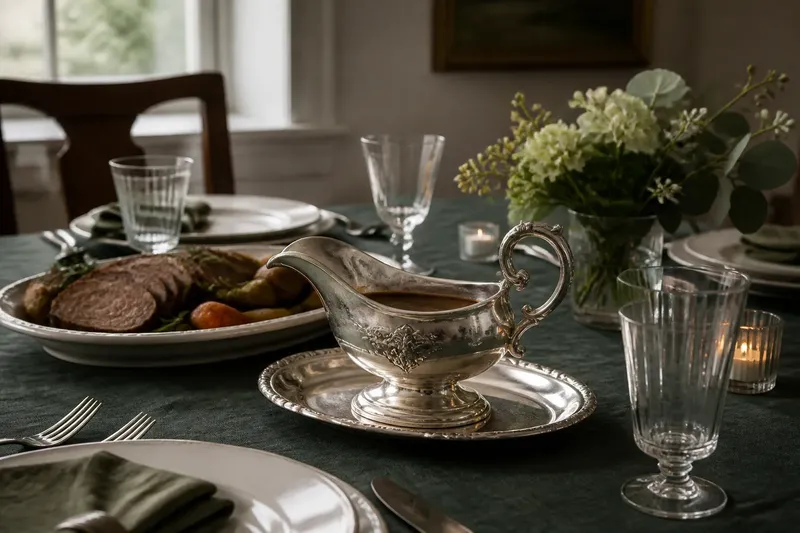
Imagine a host planning a supper with one silver sauce boat for a roast and vegetables. They place it near the serving dish, choose plain white plates and a deep green cloth, and leave the rest of the table free of silver ornaments. The expected result is a clear visual centre that remains useful when guests begin passing food.
If the object is too small to serve comfortably from the table, keep it as a focal accent and place the actual serving vessel nearby. If it is large, allow it to occupy its own zone rather than squeezing it between glasses. The object’s scale should set the rhythm of the arrangement, not dictate that every place setting carry a matching ornament.
What colours and materials make silver stand out?
Use contrast, but keep the palette narrow. White, cream, slate, muted green and deep blue can all make a silver surface legible without competing with it. Choose one main cloth colour, one plate colour and, if useful, a smaller accent in napkins or flowers.
Texture often does more than another colour. Linen, matte ceramic, clear glass and a simple wooden board give reflected light somewhere to settle. A mirror-bright charger beneath a polished serving piece may double the shine and make the centre feel busy; a softly textured cloth usually gives the object a calmer edge.
Keep patterns selective. A patterned tablecloth, patterned plates and printed napkins create several visual centres before the silver arrives. If the plates carry a border, use a plain cloth. If the cloth has a strong weave or motif, let the ceramics stay quiet.
How much space should the centrepiece have?
Leave enough open table around the silver for it to be recognised as one object and used without awkward manoeuvring. Its outline should not disappear among dishes, candles and flowers. Nor should it block sightlines across the table or make guests reach over one another.
Arrange the table in working zones. Keep plates and cutlery at each place, drinking glasses within easy reach, and shared food in a central area that leaves a route for passing dishes. Place the silver serving piece where its function belongs within that pattern, then remove any decoration that occupies the same space without helping the meal.
Low flowers can sit to one side if they do not obstruct conversation or access. Candles should be positioned with care around fabric and serving traffic; if the table is already crowded, omit them. Empty space is not a missing decoration. It is room for hands, plates and the occasional late arrival carrying a bowl.
What should you pair with one silver serving piece?
Pair it with objects that have different jobs and quieter surfaces. A ceramic platter can hold the main dish, clear glass can provide lightness, and a linen napkin can soften the hard reflections. Repeating silver at every place setting is unnecessary; ordinary stainless-steel cutlery can sit comfortably beside one silver focal piece.
- Plates: Choose plain or lightly patterned ceramics so their rims do not compete with the serving piece.
- Cloth: Use a solid colour or subtle weave that offers contrast without a strong printed motif.
- Glassware: Keep forms simple, especially if the silver has elaborate decoration.
- Flowers: Choose a low arrangement or a few stems in a modest vase, placed clear of serving routes.
- Cutlery: Use what guests need for the meal rather than adding decorative forks or spoons for symmetry.
These are choices, not a formula. A spare table can suit a sculptural piece; a fuller family meal may need more bowls and platters. The useful test is whether each addition has a purpose and whether the silver remains easy to see and use.
How can you adapt the arrangement for different tables?
On a narrow table, place the silver serving piece near the dish it serves rather than insisting on a central position. A central object can be visually tidy but practically inconvenient when it separates guests from the food. On a broad table, a single focal object may need a quiet supporting element, such as a low bowl of fruit, to prevent the far end from feeling unrelated.
For a small gathering, a serving piece can sit close to the host’s place and move when needed. For a larger meal, position it where it can be reached from the relevant side, keeping handles and lids clear of glasses and sleeves. The layout should follow the room and the route food will take, not a diagram designed for a different table.
If the silver is borrowed or especially delicate, use a stable surface and avoid placing it at an exposed edge. Follow the maker’s care and handling instructions; where those are unavailable, ask the owner how they want it treated.
What do people ask about a silver-centred table?
Can one silver serving piece look intentional on its own?
Yes, if it has a clear place in the meal and enough visual space around it. A restrained setting makes its material and shape easier to notice than a collection of unrelated decorations.
Does the rest of the cutlery need to match?
No. Stainless-steel cutlery is a practical companion, and its quieter role can help distinguish the single silver serving piece. Matching every utensil may shift the table towards a formal display rather than a usable meal.
Where should the serving piece go if the table is small?
Put it beside the dish it serves, even if that is off-centre. Clear access matters more than symmetry, and guests should not have to reach across another place setting to use it.
What if the silver piece is mostly decorative?
Give it a stable place that does not interrupt serving or conversation, then keep nearby decoration modest. If it has no practical role, its value as a focal object depends on allowing its form and finish to remain visible.
How can you tell when the table is finished?
Stand back from the table at the height guests will see it. Check that the silver serving piece is visible, the meal’s shared dishes can be reached, and no tall object interrupts conversation. Then sit in a place that seems likely to be awkward and inspect the view from there as well.
Remove one item if the centre feels crowded. This is often more useful than adding another decoration to balance it. A place setting built around one silver serving piece works when the object belongs to the meal, the surrounding materials give it contrast, and the open table still invites people to sit down.